

Growing in the ServiceNow Ecosystem: Growth 2.0 Techniques
The value of ServiceNow's vast relationship ecosystem is just as important as its platform. ServiceNow's expansion across industries is generating previously unheard-of chances for partners to develop and prosper as it speeds up the worldwide enterprise IT transformation. Following the developed partner program, we at GTD have kept a close eye on these trends and have recognized a new age of growth for partners. We refer to this revolutionary time as Growth 2.0, a potent stage where partners can use a variety of growth tactics to propel their own growth and increase their influence inside the ServiceNow ecosystem.
This was reiterated at the most recent Global Partner Ecosystem Summit in Santa Clara, when CEO Bill McDermott urged partners to communicate openly, saying, "Just tell us what you need... Let's get it sorted." Let's use trust. Everything is fine. And let's go for growth." This call to action demonstrates ServiceNow's dedication to providing partners with the tools, confidence, and assistance they require to thrive, laying the groundwork for reciprocal development and success in a changing environment. Therefore, this ecosystem provides a clear route to increasing effect and attaining sustainable success for businesses seeking to strategically enter new industries or expand their ServiceNow expertise.
Additionally, McDermott identified India, Southeast Asia, and Latin America as important development areas, highlighting the possibility that ServiceNow's reach might go beyond its robust position in the U.S. and EMEA regions. He underlined that the partner ecosystem's active assistance is necessary to achieve these goals. Partners have a timely window of opportunity to increase their market reach and draw in fresh growth investments to bolster and scale their capabilities thanks to this growing worldwide presence.
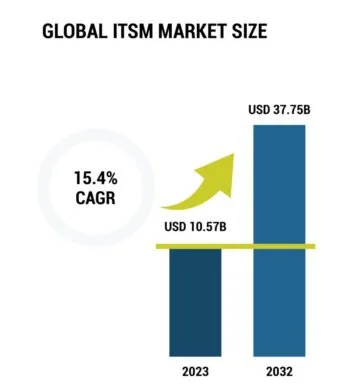
The expanding ITSM market is the primary driver of these prospects. The global ITSM market was estimated to be worth USD 10.57 billion in 2023 and is expected to increase at a compound annual growth rate (CAGR) of 15.4% from USD 10.57 billion in 2024 to USD 37.75 billion by 2032, according to Fortune Business Insights.
Accordingly, we highlight a few key facts that demonstrate how ServiceNow's effective positioning and enterprise-wide expansion present an exciting opportunity for its partner community in their "Growth 2.0 Journey":
Updated Partner Approach
In order to spur growth through innovation and distinction, ServiceNow unveiled an updated partner strategy. Partners can highlight their experience using the new designation system, making them stand out in a crowded market. These partners are positioned for long-term success by using the platform's resources to better address the changing needs of clients thanks to ServiceNow's ongoing support.
Because ServiceNow's prior partner program used a point-based system based on 37 criteria, many partners were able to achieve elite status, which ultimately reduced the program's exclusivity. In the words of Michael Lombardo, CEO of GlideFast Consulting, "If everyone is elite, nobody is elite." The revised program makes it easier for partners to stand out within the ServiceNow ecosystem by introducing more precise certification requirements.
Growing in the ERP Industry
With its Procurement Service Management solution, ServiceNow has entered the ERP sector, giving its partners additional opportunities. Organizations require cross-departmental integrated solutions, but old siloed systems can impede agility, according to McDermott. By bringing people, data, and technology together on a single platform, ServiceNow's Finance and Supply Chain Workflows enable effective operations and automation without requiring expensive migrations.
Many businesses are looking for ways to improve procurement and overall operational efficiency since global supply chains continue to face difficulties. By including ERP and legacy ServiceNow products into their portfolios, partners may take advantage of this opportunity and assist clients in resolving procurement-related issues while leveraging the possibility for cross-selling that results from these enhanced capabilities. In addition to expanding ServiceNow's range of solutions, this action enables partners to provide more value throughout the company.
Artificial Intelligence
The Now Platform's integration of AI boosts efficiency and productivity, which eventually improves worker performance and enriches consumer experiences. In order to improve efficiency across a variety of organizational areas, such as IT, customer service, and procurement, ServiceNow just released Xanadu, which further adds a range of generative AI capabilities and sophisticated AI agents. With its new capabilities, Xanadu speeds up transactions and enables businesses to develop customized AI solutions that improve processes and data management.
This major update gives ServiceNow partners the chance to take advantage of these improvements in providing tailored solutions, streamlining client operations, and demonstrating the benefits of AI-driven procedures. Partners position themselves as vital facilitators of digital transformation, propelling customer success and cultivating enduring partnerships, since they can deploy and incorporate these technologies into their offerings. This development coincides with Gartner's prediction that GenAI will increase ServiceNow's TAM by $1 trillion.
Industry-Specific Solutions
Partners are being forced to specialize on apps that address certain processes and needs as a result of customers' growing need for solutions catered to their industry-specific difficulties. This increases the platform's influence in vertical markets. For partners concentrating on industries including telecommunications, manufacturing, media, financial services, public sector, and healthcare/life sciences, ServiceNow's continuous investment in industry-specific solutions is essential since it provides a concentrated approach to resolving challenging industry issues.
Partners can expand their knowledge and provide highly tailored solutions that satisfy specific industry needs by concentrating on these important industries. Customers in these markets are therefore actively looking for partners that can offer specialized goods and services and who comprehend their particular contexts, setting partners up for significant growth.
Possibilities for Cross-Selling and More
As the platform grows outside its core IT capabilities, ServiceNow partners have plenty of chances to cross-sell. Partners can increase platform usage across departments by introducing customers to new HR, customer service, and creator workflow solutions through ITSM or ITOM. They can also improve current workflows with AI analytics and automation tools, increasing productivity and value.
Partners thrive by utilizing the platform's growing capabilities and the innovation from ServiceNow's R&D, as noted by David Parson, former SVP of Global Alliances and Channel Ecosystem at ServiceNow. Partners may provide comprehensive services that improve their ITSM offerings and spur growth by expanding upon and utilizing ServiceNow's technologies. This gives them a lot of chances to improve their ITSM services, add value, and spur growth through clever cross-selling and upselling. Partners may address a variety of client needs while accelerating their own success by staying innovative and keeping up with ServiceNow's innovations.
How can you accelerate this Growth 2.0 journey using M&A?
Larger ServiceNow partners are making major investments to promote organic development in the current wave of consolidation, using their scale and growing capabilities. As the partner ecosystem develops, companies with extensive service offerings, strong certifications, and deep specialization are becoming more and more dominant in the market.
They may access unexplored growth frontiers and increase their competitive relevance by entering new areas where ServiceNow is growing through strategic alliances and investments.
Partnerships, investments, or strategic exits with bigger players can help you in the following ways:
Fulfilling High Client Demand: ServiceNow clients seek partners with advanced capabilities in a variety of specializations, such as advisory, consultancy, and implementation services, in addition to having Elite or Global Elite status. Rapid upskilling and certification expansion can be facilitated by M&A with a larger partner, assisting businesses in meeting demanding client expectations without the time and resource commitment usually needed to satisfy these criteria on their own.
Increasing Service Offerings with End-to-End Capabilities: The partner ecosystem is moving toward providing all-inclusive, integrated solutions. Bigger companies like SoftwareOne and Cognizant have effectively integrated consultation, implementation, optimization, and custom development services to create one-stop solutions that are more appealing to business clients. Smaller ServiceNow partners can gain access to these enhanced service capabilities by partnering or merging with a larger organization. This enables them to compete for bigger projects and give clients with a more seamless experience without having to start from scratch.
Improved Market Access and Geographic Reach: As ServiceNow expands internationally, so does the need for partners who are well-established in several areas. For smaller businesses that might not have the resources to independently enter new markets, geographic expansion might be difficult. A smaller company can greatly expand its reach, credibility, and clientele by partnering with or being bought by a larger player that has established talent pools and client ties in high-growth markets. This will put the company in a position to grow more quickly and sustainably.
Access to Scale and Specialized understanding: Smaller ServiceNow partners who contribute specialized capabilities (such as industry-specific solutions or deep technical understanding) may discover substantial benefits in joining forces with a bigger partner in an environment where niche expertise is highly prized. Larger players gain from the acquisition of specialized knowledge, while smaller businesses might take advantage of the buyer's resources and market power. When they work together, they can build a more powerful, diverse organization that can handle challenging tasks and draw in well-known clients.
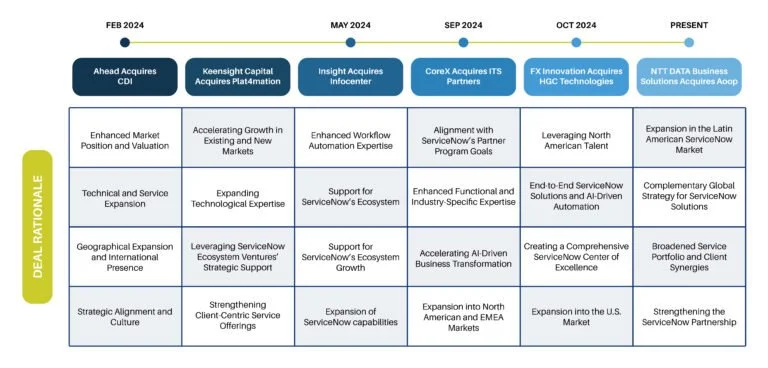
Here is a summary of the ServiceNow M&A transactions that have occurred thus far in 2024. The main M&A motivators for these deals are also noted.
In conclusion
A number of strategic investors and larger consulting partners seeking to expand their ServiceNow portfolio and offerings and meet current demand by investing in the right ServiceNow partner who can bring complementary capabilities and scale together, as well as the growing demand for specialized ServiceNow capabilities, are the reasons GLobal Tech Developers Advisors anticipates that the pace of such strategic acquisitions or investments in the ServiceNow partners will accelerate further towards the beginning of 2025. We expect several acquisition offers and appropriate valuations for ServiceNow partners with unique skills, solutioning-led revenues, and synergies that can be added to the current portfolio due to the increasing transaction flow and interest from a wider range of investors.
Partners have many chances to develop and innovate thanks to ServiceNow's strategic expansion. In order to stand out and provide more value, ServiceNow partners can concentrate on their organic growth strategy in a number of ways, such as by utilizing generative AI, developing new ERP solutions, creating recurring revenue streams, concentrating on particular industries, or strategically cross-selling and upselling.
Bigger ServiceNow partners are also in a good position to make strategic acquisitions to strengthen their competitive advantage. They may deepen their vertical expertise, increase their skills, and meet the growing demand for ServiceNow solutions by integrating complementary firms. This strategy facilitates the long-term expansion of the ServiceNow ecosystem by streamlining operations and enabling a quicker reaction to changing market demands.
To accelerate their growth trajectory, small to mid-sized partners could look into partnership or outside investment alternatives. Currently, collaborating with larger partners or establishing revenue-sharing alliances offers a possibility to not only expand but leapfrog when it comes to meeting evolving ServiceNow program needs. In order to eventually maintain or attain Elite status, this method enables increased market access, improved service capabilities, and resource pooling.
As we anticipate a strong start to an exciting 2025 for the ServiceNow ecosystem, we at GTD think that ServiceNow partners who are quick to adjust and align with ServiceNow's new strategy and develop deeper capabilities and relevance within the ecosystem will have a clear investment proposition and are likely to see greater access to flexible growth capital from several strategic acquirers and investors.