

How Businesses Can Do More With Less Thanks to RPA
Companies of all sizes and scales are always trying to improve the quality of their services and cut expenses without significantly altering their current procedures. Robotic Process Automation (RPA) is useful in this situation. RPA is essentially the process of teaching a software robot to perform new iterative tasks effectively and at scale without altering the system in question. According to estimates, operational expenses can be lowered by 25–50% when robotics is used for specific applications or procedures.
Businesses have become more aware of the need for automation, including Robotic Process Automation (RPA), as a result of the pandemic, in addition to the requirement for a more robust and adaptable operating model. Without RPA, businesses frequently lose out on fantastic chances to increase productivity during a period when many are attempting to keep expenses under control. GrandView Research estimates that the global robotic process automation market would grow at a compound annual growth rate (CAGR) of 34% from 2020 to 2027, from its 2019 valuation of $1.40 billion to $11 billion.
Organizations are searching for innovative methods to streamline and expedite the adoption process and enhance return on investment in response to the increasing demand for RPA. Companies are investing in RPA to assist shorten development cycles in a variety of industries, from banking and healthcare to supply chain and agriculture. While banks can now provide 24/7 chatbots, mobile banking, and quick customer care for both personal and business accounts, RPA is also revolutionizing supply chains by updating inventory management and forecasts.
Strong client demand for business automation and digital transformation solutions is fueling the rapidly expanding RPA software market's continued merger and acquisition activity. Global RPA software revenue is expected to increase by 19.5% from 2020 to $1.89 billion in 2021, according to Gartner. The RPA market, which Gartner identified as the fastest-growing sector of the global corporate software market, has seen the following recent investments:
In order to help its clients automate repetitive processes, enhance automation, and interact with both modern and legacy systems, digital workflow firm ServiceNow acquired RPA business Intellibot.
RPA startup UiPath closed a $750 million Series F funding round at a post-money valuation of $35 billion, marking a more than three-fold increase from a valuation of $10.2 billion when it raised $225 million in funding in July of last year. Coatue and Alkeon Capital co-led the round. Customers may design, manage, run, engage, monitor, and control automation across departments within a company with the help of UiPath's automation platform.
In order to quickly adopt market demands and offer clients fresh, creative solutions centered around RPA, robotic monitoring, bot auditing, and robotic test automation, QA Mentor purchased Step One Step Ahead, a privately held software consulting company specializing in RPA.
Microsoft purchased Softomotive, a developer of RPA software, to give its clients more choices for RPA desktop writing, enabling anyone to create a bot and automate operations involving Windows.
Larger businesses are aiming to automate routine office chores in order to speed up their business processes, which is why RPA adoption is growing quickly. Additionally, by combining RPA with cognitive technologies like Artificial Intelligence, Machine Learning, Natural Language Processing, and Speech Recognition, businesses can take their automated tasks to the next level, having them perform work that in the past depended on human perceptual and judgment capabilities. RPA has aided in the automation of clinical testing for a workable vaccine, the acceleration of COVID-19 testing, the centralization of employee health data, and the promotion of contact center usage. Information sharing on COVID-19 and its spread, network traffic monitoring, processing government loans to small enterprises, and handling customer cancellation or purchase orders are some possible applications for RPA during these periods.
The following are the main RPA trends that are anticipated to emerge in 2021 based on the lessons learned from the pandemic, with RPA having won a spot in IT managers' toolkits as a straightforward approach to streamline various business procedures and make better use of raw data:
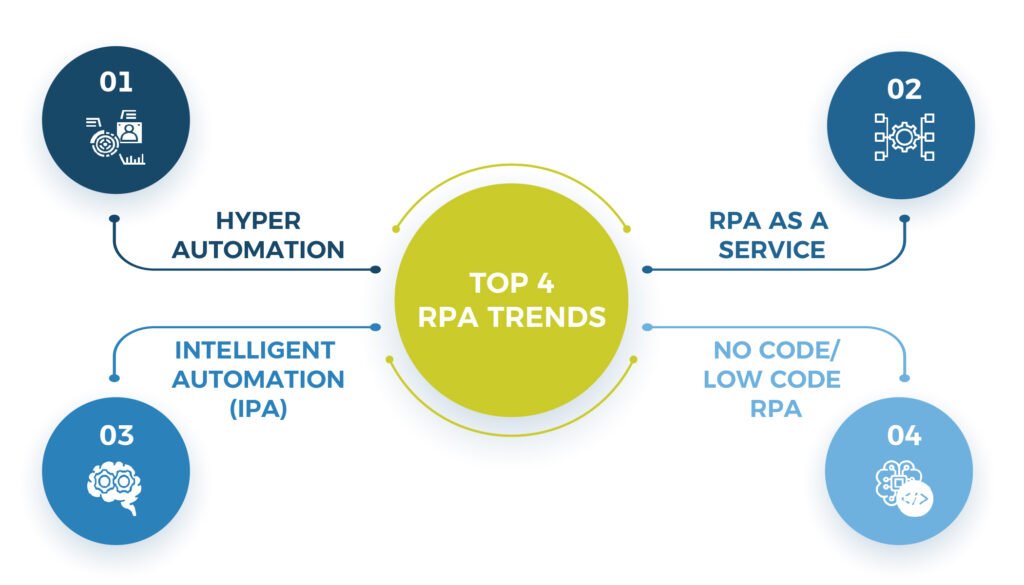
HYPERAUTOMATION
From task automation to orchestration to intelligence, hyperautomation will propel higher-level functioning, facilitating processing mining, adaptive decision-making, guided recommendations, and predictive insights. Almost any use case that is a suitable fit for hyperautomation can be automated, opening up a new world of possibilities where even extremely complicated business processes can be automated from start to finish. According to Gartner, the market for technologies that enable hyperautomation is expected to grow from $481.6 billion in 2020 to $596 billion in 2022, a roughly 24% increase. Additionally, vendors of hyperautomation are collaborating with various businesses to develop and market RPA solutions. In 2019, for instance, UiPath partnered with DVT, a South African provider of AI and data analytics tools, to develop sophisticated RPA solutions. Gartner predicts that by 2024, businesses will save operating expenses by 30% through the integration of new operational procedures with hyperautomation technology.
RPA AS A SERVICE
During the pandemic, several sectors are welcoming RPA's transition to the mainstream "as a service" model. The cost of development, deployment, and maintenance is gradually reduced by this adoption. RPAaaS enables businesses to streamline operations and standardize procedures across multiple departments. It improves customer service and fosters greater cooperation and coordination inside the company.
INTELLIBENT AUTOMATION (IPA)
An growing collection of new technologies known as IPA blends machine learning, robotic process automation, and basic process redesign. The market for intelligent process automation is expanding as a result of the growing use of process automation by the IT, BFSI, healthcare, and telecommunications sectors. Global IPA spending is expected to increase from $8.4 billion in 2020 to $13 billion in 2023, according to Statista. Another significant driver propelling industry expansion is an increasing number of acquisitions. For example, Blue Prism acquired Thoughtonomy, an intelligent automation company, in order to enhance its connected-RPA platform offering with the latter's Software as a Service (SaaS) capabilities. This would allow customers to increase productivity without requiring specialized infrastructure.
NO CODE/LOW CODE RPA
Employees can create basic apps by combining RPA technology with low code application development, which is quite helpful. It can be connected to their current automation, which will simplify its operation and lessen their daily workload. The goal of no code RPA solutions is to eliminate the requirement for RPA coding entirely. Even while the majority of popular RPA technologies have long supported user experience (UX), the UX of these tools is typically very limited, and developers mostly use code to automate operations. Combining RPA technology with low code application development is very helpful since it allows employees to create basic applications, which is especially helpful given the anticipated continued prevalence of remote working. It can be connected to their current automation, which will simplify its operation and lessen their daily workload. SAP introduced RPA and low-code technologies last year in an effort to attract citizen developers to its platform.
In order to gain and preserve a competitive edge in their sector, more businesses are investing in RPA as we move forward. Businesses can have more operating capacity and provide a better customer experience by utilizing the technologies that are available to boost employee productivity and cut expenses. As specialized skills that integrate RPA with AIOps and Cloud become more relevant, we at GTD anticipate that the spectrum of opportunities within the industry will expand dramatically. We also continue to observe strong investor interest in RPA firms. These specialized skills and concentration can frequently result in a complementary set of solutions and go-to-market development through strategic alliances, investments, and M&A, which can change growth paths during this exciting period in the RPA business.