

Investors Prepare for Growth Prospects in Cybersecurity
With increasingly skilled attackers probing the dark corners of our systems and networks, 2026 is already looking like one of the most difficult years on record for cybersecurity. In recent years, businesses have come to understand that cybersecurity isn't just a check-the-box exercise; it must be a core part of their operations, services, and cultures. As a result, businesses are essentially forced to increase their cybersecurity efforts. This change has been fueled by a number of factors, including the quick digitization of various industries and sectors, the growing use of cloud services and Internet of Things devices, the increasing accessibility and efficacy of digital communication and collaboration tools, the widespread adoption of remote work, and the sophistication and frequency of cyberattacks.
Due to the increased demand for cybersecurity, the industry has seen a surge in mergers and acquisitions this year, with around 40 companies being purchased up until early October 2025.
Large companies like Accenture and Deloitte filled in the gaps in their product strategies by acquiring smaller, specialized firms, and both strategic and private investors rushed to invest in these cybersecurity firms, capitalizing on the growing demand for cyber protection. Throughout 2020 and 2021, the industry saw many of its largest players pursue acquisitions.
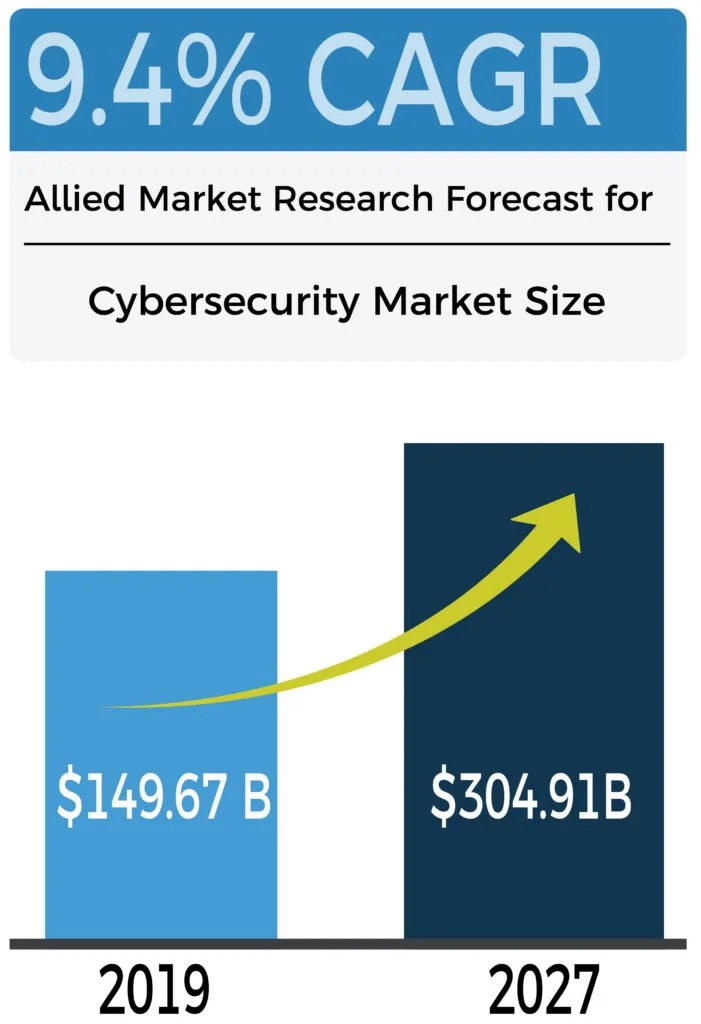
Over the last decade, the global cybersecurity industry has expanded quickly, and the pandemic further heightened its importance as many companies were forced to shift operations online. Allied Market Research estimated the market at $149.67 billion in 2019, projecting it to grow at a 9.4% compound annual growth rate from 2020 to 2027 and reach $304.91 billion. Investment has stayed robust alongside a rise in mergers and acquisitions, with Crunchbase reporting that more than $14 billion has already been invested in cybersecurity this year.
Despite the sharp rise in cyberattacks in recent years, many organizations still struggle to keep pace with constant changes that make security awareness increasingly critical. Recognizing these vulnerabilities, companies are investing more in cybersecurity providers, especially as data centers—central to modern operations and responsible for delivering reliable, scalable access to essential data and applications—require stronger protection. As their importance grows, so does the need to monitor and safeguard them effectively.
At the same time, emerging technologies such as artificial intelligence and machine learning, along with hyper-automation, are making cybersecurity more automated and more efficient in managing risk. These innovations enable better threat detection and deeper analysis, helping cybersecurity companies build stronger solutions and generate greater revenue. Because the right technology mix differs across organizations, businesses now need to adopt multiple layers of cybersecurity measures. Recent strategic partnerships between specialized cybersecurity firms and major global technology consulting companies further demonstrate that cybersecurity has become indispensable across industries and company sizes.
To enhance its cybersecurity portfolio with established frameworks, methodologies, and technology-driven tools for industrial control systems and operational technology (ICS/OT) security, Deloitte acquired the industrial cybersecurity unit aeCyberSolutions from aeSolutions. The deal also brought in aeCyberSolutions specialists known for deep expertise in risk advisory and industrial standards development. As Deloitte’s fifth cyber acquisition in 2021, the move underscored its commitment to expanding capabilities and helping clients address a broad range of cyber risks.
Rapid7 purchased IntSights Cyber Intelligence to combine Rapid7’s internal threat-intelligence technologies with IntSights’ external threat-intelligence capabilities. The integration provides organizations—regardless of size or maturity—with a unified view of threats, attack-surface monitoring, actionable insights, and proactive mitigation. The acquisition also strengthens Rapid7’s cloud-native extended detection and response platform, InsightIDR, enabling higher-fidelity alerts, faster detection, and improved response times.
Meanwhile, Thoma Bravo sold a majority stake in Centrify to TPG Capital, part of TPG Inc.. The investment reinforced Centrify’s leadership in privileged access management and identity security. Its platform addresses cyber threats by enforcing least-privilege access for users and systems at scale—both on-premises and in the cloud—helping organizations reduce administrative-access risk, improve compliance, and automate privileged-access controls.
These transactions highlight one of the most active periods of mergers and acquisitions in the sector, underscoring both the growing necessity of cybersecurity and the willingness of larger companies to invest in specialized providers. Given the rapid pace of technological innovation, developing new products organically is time-consuming and carries significant risk, particularly in achieving strong product-market fit while managing market and scaling challenges.
While cybersecurity was once viewed as just a component of enterprise IT operations, the increasing number of security breaches—and the investments made to address them—has pushed it to the forefront for businesses and global investors alike, according to GTD. More organizations now recognize that appropriate investment is the most effective way to prevent data breaches. As a result, investor demand for cybersecurity vendors and experts remains strong, and the sector’s growth potential is expected to expand significantly.