

Kubernetes Investments Soar with Growing Cloud Adoption
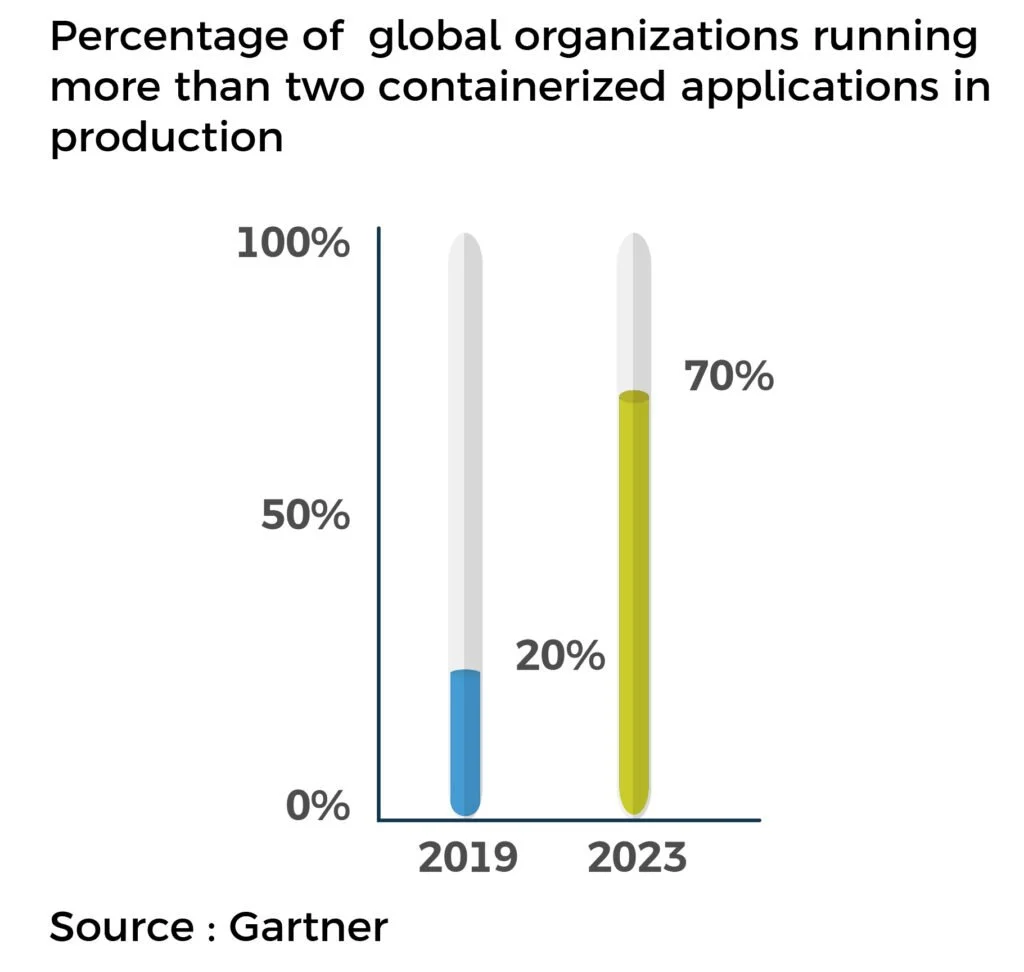
It is hardly surprising that cloud usage is growing as a result of the pandemic's impact on digital transformation. Channel partners are discovering new ways to assist their clients in operating and managing cloud services as more companies adopt cloud computing for storage, apps, and other purposes. Interestingly, though, it has also resulted in an increase in Kubernetes-based services, as more businesses use containerized software to create runtime environments with highly manageable container-based apps at scale. The biggest change in infrastructure economics since virtual servers is anticipated as a result of the growth of container technology. With the help of Kubernetes, businesses may greatly expand the use of their on-premise or cloud-hosted infrastructure because all of the computational resources are divided among several app-driven processes in a dynamic and reasonable manner. Customers who migrate cloud-native apps from their own data centers to a private, hybrid, or public cloud save an average of 50% on infrastructure expenditures.

Kubernetes has many advantages, but there are also significant technical obstacles to overcome before the technology can be widely used. Most IT teams at mid- to large-sized businesses are unable to handle the complexity of planning and coordinating massive container deployments across several cloud environments.
These businesses have started working with Kubernetes experts to address this obstacle. The following are some notable strategic alliances that specialized Kubernetes companies have formed with well-known international businesses in a variety of industries, demonstrating how Kubernetes facilitates seamless automated app deployment, operability, and scalability.
Cisco Purchases Portshift and Banzai Cloud
Within a year, Cisco reportedly paid $100 million apiece to acquire two Kubernetes-focused businesses: Tel Aviv-based start-up Portshift and Hungary-based Banzai Cloud. Cisco sought to strengthen a quickly growing portfolio of cloud-native technology being developed within its own walls through the two Kubernetes-focused acquisitions. It was anticipated that employees from both firms will support a group of Kubernetes experts working on innovative cloud-native networking and security solutions at Cisco.
It was anticipated that Portshift, which created a Kubernetes-based framework for protecting serverless apps and containers, would assist Cisco clients in enabling DevSecOps and incorporating security into cloud-native applications at an early stage in the applications' lifecycle. A variety of software solutions that tackle practical issues have been developed and implemented by Banzai Cloud, a Kubernetes-based platform that assists businesses in creating, implementing, and scaling cloud-native apps.
Both businesses reiterated their dedication to hybrid multi-cloud application-first infrastructure as the de facto manner of operating IT as a result of these two cross-border acquisitions, illustrating the cloud's globalization.
Purchase of Containership by Hitachi Vantara
Containership, a Kubernetes startup, was purchased by Hitachi Vantara. Containership wanted its clients to be able to swiftly install and manage Kubernetes clusters and containerized apps in public clouds thanks to its deployment and management capabilities. The software was anticipated to help Kubernetes users with persistent storage, audit logging, centralized authentication and access control, continuous deployment, and workload mobility.
LENS was acquired by Mirantis
Mirantis purchased the Kubernetes IDE project Lens to assist businesses in developing and administering containerized apps in Kubernetes production settings. It was anticipated that Lens will supplement the Mirantis Docker Enterprise offering with a number of management tools to assist enterprise developers in managing Kubernetes clusters in production. This would facilitate the development of applications for private clouds, Amazon EKS, Google GKE, and Microsoft AKS. Lens's consistent, user-friendly interface allowed Mirantis engineers to implement various Kubernetes features without ever losing focus. This product was thought to be a good fit for Mirantis' extensive enterprise portfolio because of capabilities like multi-cluster administration and the context-sensitive terminal.
Jetstack was acquired by Venafi
Jetstack, a U.K. company, was purchased by Venafi, a provider of certificate and key management for machine-to-machine interactions. Cert-manager, a well-known, open-source native Kubernetes certificate management controller, was developed by a firm that assists businesses with migration and operation within Kubernetes and cloud-based ecosystems. Before this, Venafi has been providing Kubernetes integrations. Jetstack and Venafi have collaborated for two years. According to Venafi, the main problem is the sheer number of machines being used in computing environments due to the growth of Kubernetes clusters, cloud instances, microservices, and more. Each machine needs a unique identity to connect, communicate, and execute securely, and system failures or misfires leave gaps for security breaches. However, Jetstack's acquisition will give it direct, in-house expertise to speed up development and deployment of better tools to meet the challenges of a rapidly expanding landscape of machines and applications, all of which require unique certificates to connect securely.
The aforementioned purchases show the widespread use of containerized apps developed on the open-source Kubernetes framework. The adaptable features and tooling capabilities of Kubernetes, which enable big businesses to collaborate with numerous partners, are the main factors driving this strong acceptance. Strategic investors seek to address issues related to development, storage, and security through these kinds of agreements. These mutually beneficial investments also speed up product development, which lowers costs and generates a steady demand for Kubernetes features that are both reasonably priced and adaptable. At GTD, we continue to observe a great deal of investor interest in Kubernetes suppliers and experts, and we anticipate that the variety of opportunities in this market will expand dramatically.