

Leading AI Trends: Accelerated Business Transformation Powered by AI
The field of information technology has advanced rapidly over the past ten years, particularly in the area of artificial intelligence, which has evolved from a trendy term to a crucial business skill. Businesses in a variety of industries, including financial services, healthcare, and hospitality, are increasing their investments in artificial intelligence (AI) in order to get real-time insights, automate decision recommendations, and uncover new opportunities. We see a trend in the industry where more businesses are utilizing AI to boost profits, whereas prior use cases for AI were frequently motivated by cost and efficiency improvement, much like where RPA has its place.
According to CB Insights, the industry broke fundraising records in 2021, with AI startups raising $67 billion in total acquisitions, despite the worldwide unpredictability brought on by the Covid-19 epidemic. According to Statista, it is predicted to continue growing quickly after 2022 and reach approximately $126 billion by 2025. As a result, businesses in some AI-powered industries who do not adopt the trend risk falling behind their rivals.
According to research GTD has done over the last 12 months, 80% of digital executives and technology entrepreneurs think AI and machine learning are the most important fields. It is also anticipated to increase quickly in the upcoming years as we look past 2022. Nevertheless, over two-thirds (66%) of this leadership group also reported that they lacked a procedure for determining and ranking the best investment possibilities. The following are the top 6 sub-segments that are increasingly drawing investment from executives wishing to invest in AI-driven business transformation, despite the fact that there is obviously no one-size-fits-all method for selecting AI investment areas, according to our research:
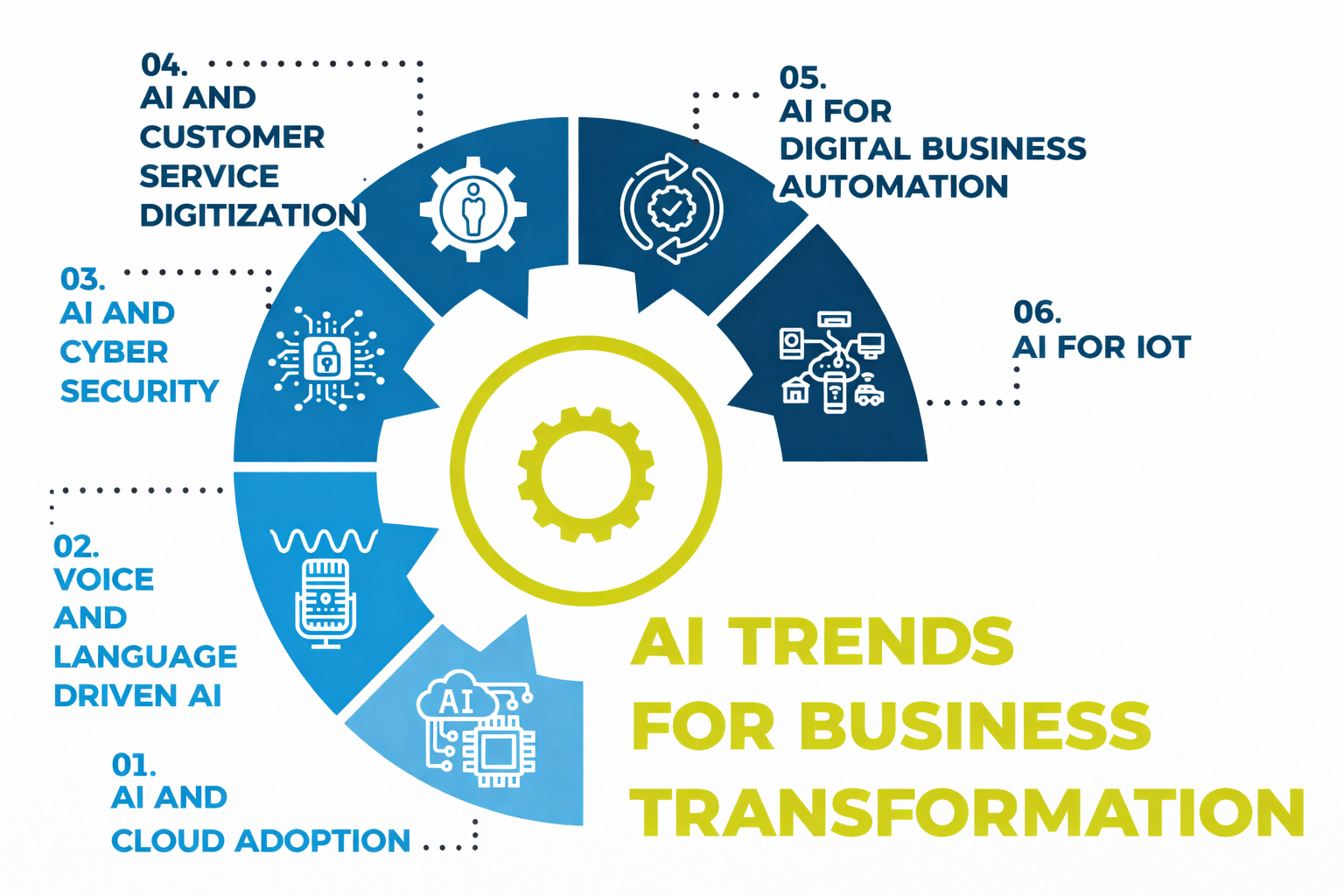
AI AND CLOUD ADOPTION
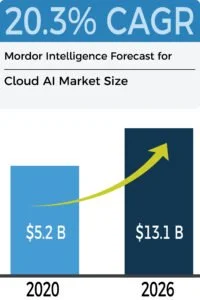
The combination of cloud computing and artificial intelligence has produced technologies that enhance the lives of millions of people. Our daily lives are infused with AI, speech recognition, and cloud computing through digital assistants like Siri, Google Home, and Amazon's Alexa. These days, artificial intelligence capabilities are layered on top of cloud computing to assist businesses manage their data, find patterns and insights in information, provide user experiences, and streamline processes. AI and cloud computing are revolutionizing many aspects of business. AIOps deployment company Nyansa was acquired by cloud services provider VMware last year in order to improve its AI and analytics capabilities.
VOICE AND LANGUAGE DRIVEN AI
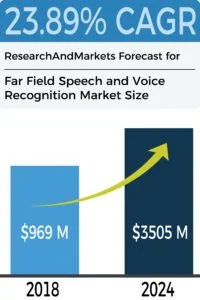
These days, developers may use chatbots, neural network models, and increasingly AI-enabled voice to create human-like experiences. Human-machine communication is made feasible by natural language processing (NLP) and natural language generation (NLG), which allow computers to comprehend, interpret, and work with human language. Voice analytics, speech recognition, artificial voice synthesis, voice transcription, and other applications that are driving corporate transformation are all part of the expanding voice AI technology ecosystem. We think Microsoft's recent $19.7 billion acquisition of AI speech recognition company Nuance was a direct response to the enormous market opportunity for AI-driven voice and natural language. While Google Siri and Amazon Alexa are leading with product ecosystems, Microsoft is taking a different approach and will now be able to leverage the base technology for voice and speech recognition acquired through Nuance to build a more software-centric approach for this market. This, in our opinion, should make it a very interesting segment to watch in the future.
AI AND CYBERSECURITY
Because AI can quickly access millions of events, automate large-scale tasks, and detect a wide range of threats, from malware to dangerous behavior that could result in a phishing attack or the download of malicious content, it has emerged as a crucial technology in information security. Over time, AI learns from the past to recognize new kinds of attacks in the present. In order to protect sensitive networks and data from cyberattacks, most businesses have continued to grow their organizations with security experts and other resources. These efforts should be progressively supplemented by investments in AI and extensive automation to replace human labor. Scalyr is a log analytics and observability software specialist that was purchased by cybersecurity analytics firm SentinelOne earlier this year for $155 million. By the end of 2030, AI will take the position of humans in cybersecurity, per a Trend Micro poll.
AI AND CUSTOMER SERVICE DIGITIZATION
No matter how excellent your product or service is, a business cannot succeed if it does not manage and enhance the customer experience. The most crucial component of every business is its customers. However, as digital technology has grown, customer connections have become less humanized and somewhat more complicated. As a result, corporate executives must devise ways to manage customer relationships in order to attract new clients and keep hold of current ones. Brands continue to use AI to generate genuine connections and the hyper-personalized experience that consumers increasingly demand in order to satisfy changing consumer expectations. Among the various AI-powered features in the customer experience arena are chatbots, voice bots, behavioral applications, biometrics, cybersecurity, speech recognition, machine translation, and automated models for labor management scheduling and forecasting. By offering smooth, ideal-match routing, complete historical awareness, and real-time context to inform recommendations, AI enhances agent performance. Last year, Fixel AI, a leading innovator in AI-powered digital marketing technology, agreed to be acquired by Weyland Tech, Inc., a global provider of eCommerce, mCommerce, and fintech business enablement solutions.
AI FOR DIGITAL BUSINESS AUTOMATION
Many companies turned to robotic process automation (RPA) as a digital transformation hack, to reorganize a new model of work amid the pandemic. RPA is faster and cheaper than a complete platform overhaul, and it reduces dependence on human workers for high-volume, routine tasks. RPA's ability to handle complex tasks like pattern recognition and cognitive automation decision-making is being enhanced by ongoing advancements in AI and machine learning. According to the most recent Gartner prediction, global sales from robotic process automation software is expected to reach $1.89 billion in 2021, up 19.5% from 2020. Even with the COVID-19 pandemic's negative effects on the economy, the RPA industry is still anticipated to expand at double-digit rates through 2024. Businesses understand that combining AI with traditional business process automation may increase the accuracy and efficiency of enterprise automation initiatives.
AI FOR IOT
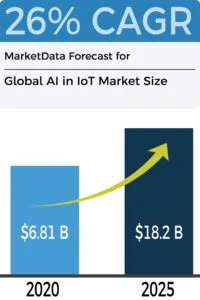
When combined with artificial intelligence (AI), smart gadgets like Google Nest, smart plugs, and smart locks—which currently only operate on command—can anticipate human requirements and initiate processes and appliances without human assistance. AI's function in the Internet of Things is to automatically spot trends and anomalies in the data produced by intelligent sensors and gadgets, such humidity and sound. The Marsden Group, a technology consulting and development company that specializes in cloud, IoT, and AI for industrial settings, was purchased by Microsoft earlier this year.
Governments and organizations are still reacting to and recuperating from the pandemic more than a year later. AI is viewed as a crucial tool in assisting businesses and organizations in responding to the need to digitize company operations and procedures in order to make an operate-from-anywhere remotely work paradigm practicable, even though no cure has been found to stop the epidemic and all of its effects. Businesses are investing more in specialist AI firms to satisfy the shift in business demand brought about by the new normal. These firms can provide complementary solutions to address growth possibilities and expand their Digital Transformation journeys.