
ServiceNow Profits from 2021's Top 5 ITSM Trends
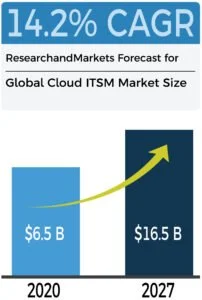
One of the most significant issues the epidemic has caused for IT departments is the large-scale relocation of workers from workplaces to their homes. Businesses have been relying on IT Service Management (ITSM) to handle remote assistance and new working methods with ease. ITSM encompasses all of the processes that go into planning, developing, providing, maintaining, and overseeing the lifecycle of IT services. The epidemic has demonstrated that, even in times of extreme stress and change, ITSM can be just as successful and effective as ever. ResearchAndMarkets projects that the global market for cloud-based ITSM, which was predicted to be worth $6.5 billion in 2020, would rise at a compound annual growth rate (CAGR) of 14.2% to reach $16.5 billion by 2027.
By creating a predictable IT organization and providing actionable IT insights to support business decision-making, ITSM implementation reduces costs and standardizes processes through organized delivery and documentation. As we discovered at their most recent investor call, ServiceNow, the market share leader in the ITSM sector, is still growing. In 2020, their revenues increased by over 30%, from $3.46 billion to $4.5 billion. A crucial component of ServiceNow's strategy has been its ongoing emphasis on innovation and experience. A.For example, a set of native AIOps and ITOM extensions complement ServiceNow's new IT Service Management solution, which aims to provide a single platform that connects ITSM and non-IT operations. ServiceNow has rapidly established a robust partner ecosystem around the product with specific capabilities, including professional services and integrations, as a result of its dominant market position.
Strong ITSM capabilities and close connectivity with partners and service providers allowed ServiceNow to make the shift to remote working. The company expanded processes to include partners that could manage important tasks with significantly less effort in order to streamline operations for clients. The pandemic has sparked the following major ITSM trends, which ServiceNow provides to help businesses on their digital journeys:
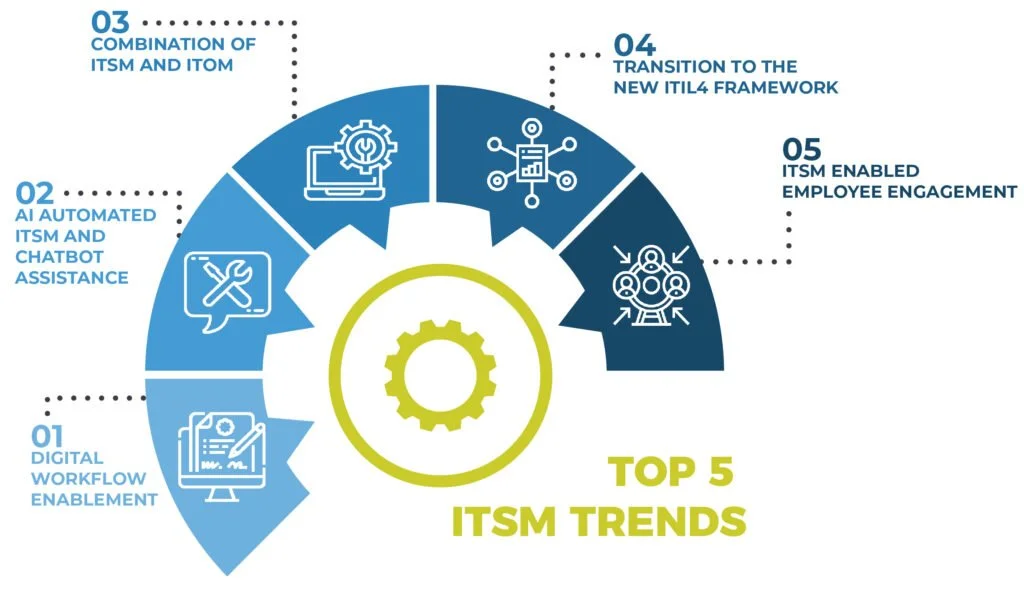
ENABLED DIGITAL WORKFLOW
The rise of digital transformation is not surprising given the necessity for digital workflows, driven by the growing mobile workforce and security and privacy issues, to enable new methods of working brought about by the pandemic. An organization needs ITSM to offer governance, stability, and understanding at the business governance level, even while digital transformation entails moving more quickly to deliver goods and services. Organizations can better understand how services are connected and how data is safeguarded while facilitating and supporting digital delivery by utilizing ITSM. It also gives employees a speedier and better service experience by allowing IT workers to focus on more value-adding duties. Milestone Technologies recently purchased ServiceNow Elite Partner and managed IT services provider Covestic of Kirkland, Washington, with the support of private equity firm H.I.G. Capital.
AI CHATBOT AND AUTOMATED ASSISTANCE
Efficient automation can assist control costs and raise the caliber of IT services by increasing the incident and change management processes' output, speed, and accuracy. AI has the potential to completely transform how IT service desks and service desk teams operate, but in order for service desks to fully benefit, they must prepare. As ITSM tool vendors start incorporating AI into their products, teams must properly document all requests, issues, and modifications, maintain an accurate service desk database, and develop a comprehensive knowledge base in order to guarantee that AI fulfills its full potential. The IT automation solutions company Abhra Inc.'s ServiceNow business unit was purchased earlier this year by UST Global, a provider of digital transformation solutions.
ITSM AND ITOM COMBINATION
ITSM and ITOM, the two components of the IT service value chain, have comparable goals, clients, overheads, and dangers. It takes preparation and work on both sides to use ITSM and ITOM cohesively, but doing so maximizes business value and agility. The combination has the potential to become genuinely innovative in terms of end-user experience and IT maturity. ITSM and IT operations management (ITOM) together provide more sophisticated automation and intelligence across IT teams while enhancing visibility and data consistency. Many current ServiceNow clients have decreased high-priority events and VPN failures, shortened service restoration times, and saved thousands of employee labor hours by expanding their IT administration to cover both machines and people. Novo/Scale, a Premier ServiceNow partner that has finished more than 1,000 projects centered on managed services, ITSM, ITOM, Integrations, Portals, and various other areas, was purchased earlier this year by private equity firm Sunstone Partners.
CHANGE TO THE NEW ITIL 4 FRAMEWORK
Building on the fundamental components of ITIL, this organized approach to ITSM has been the eagerly awaited advancement of the ITIL (IT Infrastructure Library) framework. IT workers and companies can overcome the difficulties posed by new digital technologies by using ITIL4. With the release of ITIL 4, ITSM practitioners may now take advantage of a more comprehensive approach to service management thanks to its redesigned operating model and simpler integration with other approaches like DevOps, Agile, and Lean. With Agile, DevOps, and Digital Transformation, ITIL 4 focuses on the business and technology world, how it functions now and how it will function in the future. Value co-creation requires a clear engagement with company needs and end-to-end collaboration with all stakeholders. Instead than being a framework for ITSM only, ITIL should be used for the complete IT department.
EMPLOYEE ANGAGEMENT IS ENABLED BY ITSM
In terms of ITSM, employee engagement may be characterized as a connected experience for staff members that is smooth, effective, and fully utilizes the resources and technology made available through the service desk, such as chat, mobile apps, and the service portal. Employee experience is an ITSM trend that IT service desks must take seriously due to the rising reliance on technology for work and to produce the necessary results. IT teams must quickly expand their core competencies, including incident, user, and licensing management for new devices. In a similar vein, self-help IT portals can help arrange, simplify, and automate the answering of straightforward questions. bringing people together to confront the possibility of resistance (to change) through in-person meetings, seminars, forums, and maybe simulations. A Harvard Business study found that an engaged worker is 45% more productive than one who is just content. Improving the work experience can give a company a much-needed return on investment if done correctly.
Eight ServiceNow partners have been bought so far this year, according to ChannelE2E's aggregate of acquisitions. For this expanded capability, many of the vendor's rivals depend on third-party collaborations. ServiceNow is still the top ISV Ecosystem, and major IT companies and strategic investors are pushing to develop or grow their operations around ITSM capabilities. The majority of mid-to-large IT services companies are looking for complementary ServiceNow partners with specialized expertise to enhance their ITSM and wider Managed Services offering as they expand their ITSM practice. Based on the new features and capabilities that are anticipated to replace their current legacy systems, businesses are investing in ServiceNow's ITSM partners. Through such strategic investments, ServiceNow partners are able to take expansion to the next level by gaining access to more advanced resources, larger global clients, and geographies.