
The Modernization Trinity: Using Cloud, App, and Data Modernization to Unlock Growth
The deliberate incorporation of cutting-edge technologies into an organization's systems, procedures, and infrastructures to improve productivity, flexibility, customer satisfaction, and competitiveness is known as "digital modernization." Modernization, a key element of digital transformation, concentrates on improving current investments, allowing companies to innovate without having to start from scratch while supporting the more general objectives of changing processes and attaining digital excellence.
This process necessitates organizational reorganization, cultural changes, and a reassessment of business models in addition to technical advancements. Businesses may stay relevant in a cutthroat industry and open up new revenue streams by embracing modernization.
Cloud, app, and data modernization—three interrelated pillars that serve as the cornerstone of digital growth—are essential to this transition. When combined, they enable businesses to save expenses, increase agility, engage clients, safeguard operations, and produce better results in a quickly evolving digital environment.
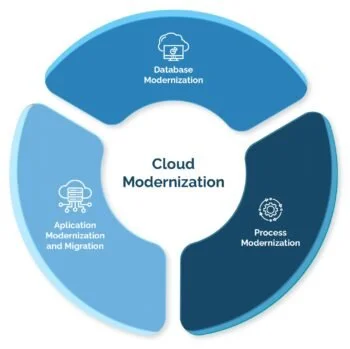
Cloud Modernization: The Basis for Change
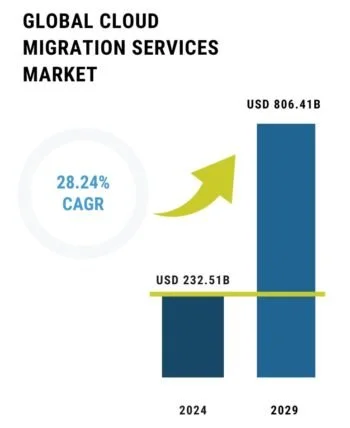
The foundation of digital transformation is cloud modernization, which provides an integrated and scalable platform for operational optimization. According to Mordor Intelligence, the worldwide cloud migration industry is expected to increase at a 28.24% CAGR from $232.51 billion in 2024 to $806.41 billion by 2029, highlighting its significance. The way firms approach modernization is changing due to key technologies like serverless computing, microservices, and AI-powered automation.
The smooth transition from old infrastructure to elastic cloud environments is made possible by cloud modernization. Agility and scalability are made possible by cloud-native designs, which are typified by microservices, containerization, and serverless computing. Multi-cloud and hybrid approaches offer flexibility while upholding resilience and compliance. These designs are essential to the modernization of apps and data because they guarantee excellent performance and system integration.
Businesses can optimize operations without compromising continuity by implementing modernization tactics including replatforming, refactoring, and rearchitecting. Real-time resource modifications are made possible by the cloud's intrinsic scalability, guaranteeing cost effectiveness and continuous service. Leading companies like AWS, Microsoft Azure, and Google Cloud are at the vanguard, enabling companies to use microservices, DevOps, and AI to maximize resource utilization and spur innovation. Cloud modernization is the cornerstone of all-encompassing digital growth, not just a technological improvement.
Modernizing Apps: Rethinking Outdated Systems
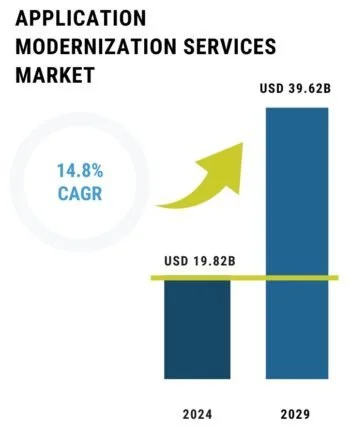
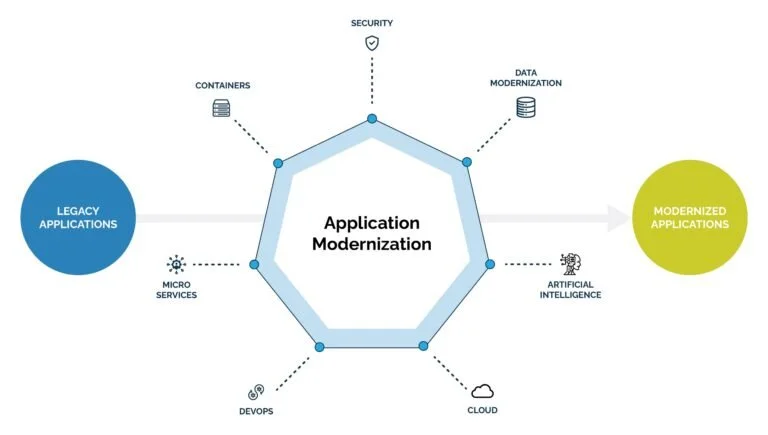
Application modernization improves scalability, functionality, and security by redefining legacy systems to satisfy contemporary demands. According to Markets and Markets, the market is projected to rise at a 14.8% CAGR from $19.82 billion in 2024 to $39.62 billion by 2029. Businesses understand how urgent it is to upgrade out-of-date systems. The way businesses modernize their apps is changing due to trends like API-first approaches, hybrid environments, and mobile-first tactics.
The design, implementation, and management of applications are all altered by modernization. While microservices decouple programs for autonomous development and scaling, tools like containerization provide consistent performance across environments. Workflows are streamlined by DevOps techniques, such as Continuous Integration/Continuous Delivery (CI/CD), which guarantees quicker time-to-market and increased dependability.
By allowing programs to execute only when necessary and lowering operational overhead, serverless computing adoption further improves efficiency. Businesses use AI/ML-powered advanced analytics to gain fresh perspectives and spur expansion. Leading companies like IBM, Accenture, and Infosys are in the forefront, providing specialized solutions to deal with compatibility issues, high migration costs, and talent gaps.
For companies looking to be flexible and competitive in the quickly changing digital ecosystem of today, application modernization is a strategic necessity. It entails more than simply updating antiquated systems; in order to spur innovation and provide better customer experiences, a holistic strategy that synchronizes technology with business objectives is needed. Organizations can break free from the limitations of monolithic systems and set themselves up for future expansion by employing DevOps techniques, utilizing cloud platforms, and adopting modular architectures.
Progress is frequently hampered by high relocation costs, reliance on antiquated infrastructure, and shortages in technical knowledge. Modernization initiatives include end-to-end services—from thorough evaluations and strategy development to implementation and ongoing support—to get beyond these obstacles. This guarantees that companies can minimize risks and disruptions while successfully navigating difficulties. Organizations can accomplish shorter development cycles, lower operational costs, and preserve resilience in competitive marketplaces by incorporating cutting-edge technologies like automation, microservices, and containerization.
Data Modernization: Unlocking Insights in a Digital-First World
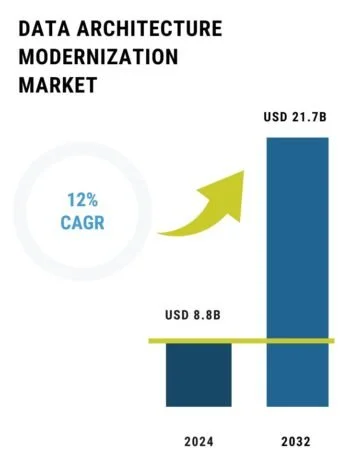
By redefining how companies handle, store, and analyze data, data modernization facilitates strategic decision-making and actionable insights. Organizations are giving modern data solutions first priority as the market is expected to increase at a 12% CAGR from $8.8 billion in 2024 to $21.7 billion by 2032, according to Business Research Insights. AI, ML, and IoT integration as well as the need for real-time analytics capabilities are important motivators.
Data management is moved from inflexible on-premises systems to adaptable cloud-based architectures as a result of modernization. This evolution revolves around data lakes and warehouses, which provide strong analytics for structured datasets and affordable storage for unstructured data. Businesses can improve decision-making and obtain predictive insights by combining these frameworks with AI/ML-powered analytics.
The foundation of contemporary data systems is cloud storage, which allows for seamless integration, scalability, and security. Cloud-powered real-time analytics improves data accessibility and processing speed, enabling businesses to stay responsive to market needs. Elastic storage optimizes costs and promotes teamwork by dynamically scaling resources.
Industries are changing as a result of trends including the use of hybrid clouds, real-time analytics, and AI-driven processing. Regional dynamics show how Asia-Pacific is expanding quickly due to the use of big data analytics, while North America is leading. Businesses like IBM, Microsoft Azure, and SAP offer state-of-the-art data migration and modernization solutions.
Modernizing infrastructure is only one aspect of data modernization; another is building dynamic, integrated ecosystems that spur growth and innovation. Businesses can future-proof their data infrastructure and ensure resilience and agility in a data-driven environment by adopting cloud-enabled frameworks and advanced analytics.
Trends in mergers and acquisitions and noteworthy transactions
The modernization sector's mergers and acquisitions (M&A) environment is a reflection of how quickly sectors are undergoing digital change. Companies are increasingly using strategic acquisitions to improve their capabilities, with the cloud migration market expected to reach $505.85 billion by 2028, the application modernization market expected to grow to $42.64 billion in the same period, and the data modernization market expected to hit $21.7 billion by 2032. Through strategic investments or M&A, mid-market strategic and PE investors are driving this trend by seeking to expand and grow cross-domain capabilities spanning cloud-native architectures, sophisticated analytics driven by AI/ML, and integrated modernization frameworks.
Most investors don't think it's worthwhile to build organically in order to avoid falling behind in the fiercely competitive and rapidly expanding modernization market. We observe a rise in the amount of money our clients and investors are allocating to the purchase of specialized modernization companies with unique capabilities that can handle important needs like data migration, mainframe modernization, and the integration of cloud and AI technologies. In these cases, we could scale revenues through a significant Go-To-Market expansion in the US, UK, and Western Europe. Through a win-win participative investment paradigm, these symbiotic synergistic strategic investments not only improve scalability, agility, and innovation but also allow entrepreneurs to unlock multiplied growth and accelerated value creation.
BLAZECLAN TECHNOLOGIES ACQUIRED BY ITC INFOTECH
Blazeclan Technologies, a worldwide provider of cloud solutions, has been bought by ITC Infotech India Limited, a wholly-owned subsidiary of ITC Limited and a prominent supplier of IT services and digital solutions. Blazeclan is an AWS Premier Partner and Snowflake Elite Partner with operations in India, Singapore, Australia, the USA, and Canada. The company specializes in cloud migration, digital cloud consulting, data analytics, and digital services. Its headquarters are in Pune, India. With this acquisition, ITC Infotech's capacity to offer multi-cloud and hybrid cloud solutions is strengthened, improving its capacity to assist clients in their digital transformation processes. ITC Infotech is positioned to achieve business outcomes based on strong cloud capabilities and accelerate expansion across international markets by combining Blazeclan's experience in cloud transformation with its well-established partner ecosystem.
ONIX GETS DATAMETICS
Datametica, a well-known IP-powered consulting firm, has been purchased by Onix, a Google Cloud partner with expertise in cloud migration, application modernization, geospatial solutions, and generative AI. Datametica, which has its headquarters in Pune, India, is an expert in data transfer, modernization, and analytics. It uses proprietary tools to automate and speed up these operations for Google Cloud clients. Through this purchase, Datametica's strengths in data migration and analytics are paired with Onix's cloud expertise, allowing the combined company to provide comprehensive, data-driven solutions for enterprise transformation. With a focus on speeding AI and data value creation, the new organization serves more than 1,800 clients across industries and operates in more than 20 countries. Onix and Datametica's combined strengths make them a formidable force in cloud transformation, data modernization, and artificial intelligence, providing organizations all over the world with unparalleled results.
FOGHORN CONSULTING IS ACQUIRED BY NCLOUDS
Foghorn Consulting, a fellow AWS Premier Tier Services Partner with expertise in cloud security, migration, and application modernization services, has been acquired by nClouds, an Amazon Web Services (AWS) Premier Tier Services Partner and leader in cloud and data migrations, application modernization, managed services, and DevOps. Foghorn Consulting, a San Francisco-based company, has been an AWS Premier Tier Partner for more than ten years. Its highly qualified staff of cloud engineers specializes in infrastructure as code (IaC), CI/CD pipelines, and self-healing environments.
Through the acquisition, nClouds' offering is expanded by merging Foghorn's expertise in AWS Security, Migration, and DevOps with its leading AWS SaaS Competency in North America. In order to meet the changing needs of sectors like healthcare, life sciences, software, financial services, manufacturing, energy, and the public sector, the two firms collaborate to provide comprehensive and cutting-edge cloud solutions. With this milestone, nClouds will be able to expand operations, including geographic reach and support for clients in the public and private sectors, and expedite innovation.
AUREUS TECH SYSTEMS ARE ACQUIRED BY HAPPIEST MINDS Technologies
"Born Digital" is Happiest Minds Technologies Limited. The USA-based Azure-native digital product engineering company Aureus Tech Systems LLC, which has its headquarters in Denver, Colorado, and a development center in Hyderabad, was acquired by Born Agile, an IT company that focuses heavily on digital transformation and application modernization. Aureus, which employs 150 people, uses its experience as a Microsoft-Certified Gold & Co-sell Partner for Digital & App Innovation (Azure) to support Fortune 500 firms in the insurance, reinsurance, healthcare, and life sciences industries.
This acquisition bolsters Happiest Minds’ capabilities in the BFSI (Banking, Financial Services, and Insurance), Healthcare, and Life Sciences verticals while strengthening its Product & Digital Engineering Services (PDES) business. By integrating Aureus, Happiest Minds enhances its domain expertise, expands its value proposition, and gains access to a strong customer base with long-term digital transformation goals. Additionally, the integration enables cross-selling and up-selling of offerings such as infrastructure, security, automation, analytics, and GenAI solutions to Aureus’ clients, positioning Happiest Minds for accelerated growth. This partnership underscores a shared commitment to delivering tech-enabled business outcomes and driving digital transformation across critical industry sectors.
In conclusion:
A multi-year phased roadmap that is specific to each enterprise based on their transformation objectives, internal or external investments, and timeframes, among other crucial factors, is necessary for modernization, which is a complicated but necessary journey that calls for a strategic blend of application, cloud, and data transformation strategy. Leading international investment banking company Global Tech Developers (GTD), which focuses on strategic investments and M&A deals in the Technology, Media, and Telecom (TMT) sectors, assists investors and entrepreneurs in navigating this modernization industry transition by providing strategic growth capital to realize your vision. Proficient in promoting expansion via alliances, investments, and purchases, GTD is dedicated to assisting companies in prospering in the rapidly changing digital environment. To make modernization a reality, you need the right growth-oriented investment partners in addition to technology.