
Why the MSP Model is Changing Due to AI-Based Infrastructure Management
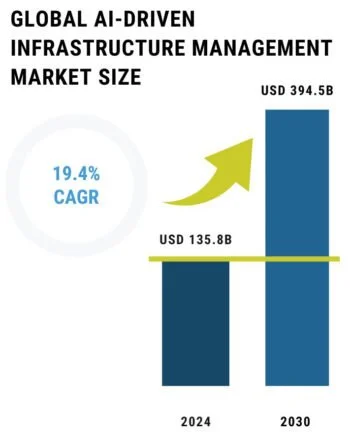
Rapid advances in artificial intelligence (AI) and growing market needs are driving a fundamental transformation in the managed services industry. As businesses struggle with expansive, dispersed IT infrastructures and growing cybersecurity threats, traditional approaches of remote monitoring and management (RMM), which rely on manual oversight and ticket-based responses, are becoming less and less effective. According to MarketsandMarkets, the AI-driven infrastructure management market, which was estimated to be worth $135.8 billion in 2024, is expected to grow at a strong CAGR of 19.4% to reach $394.5 billion by 2030. This increase highlights a dramatic move toward intelligent, automated infrastructure solutions.
New Developments in AI-Powered Infrastructure Management
Managed service providers are rethinking how infrastructure is scaled, secured, and monitored as AI becomes more integrated into IT operations. The following patterns demonstrate how AI is changing fundamental facets of operational effectiveness and service delivery.
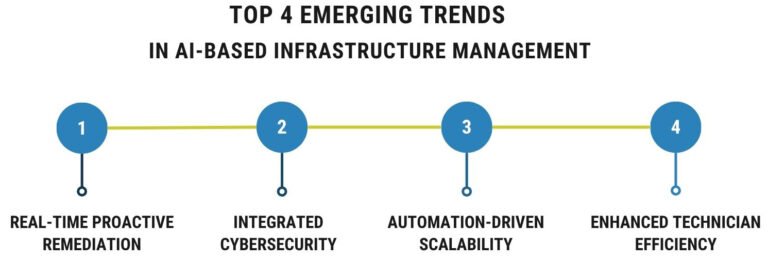
Real-Time Proactive Remediation: AI-driven platforms offer real-time anomaly detection and automatic issue resolution, drastically reducing downtime and operational disruptions.
Integrated Cybersecurity: MSPs can prevent threats by using AI-powered automated vulnerability screening and compliance enforcement, which greatly improves customer confidence and operational resilience.
Green Hydrogen and Clean Tech Integration: Engineering tools are being used to model electrolyzer systems, battery chemistries, and hydrogen logistics.
Automation-Driven Scalability: AI makes it possible for managed endpoints to grow exponentially without adding more technicians, which enhances profitability and profits.
Enhanced Technician Efficiency: By converting reactive firefighting into strategic oversight, automated monitoring and intelligent diagnostics greatly increase technician-to-endpoint ratios.
Market Environment: Players and Strategic Changes
The ecosystem of Managed Services companies (MSPs) is rapidly changing due to the use of AI by both creative startups and well-established technology companies. The use of AI-driven automation and analytics that improve proactive service management and cybersecurity capabilities is expected to push the worldwide MSP market to approach $393 billion by 2028, according to recent industry data from IDC.
Smaller specialized providers are also having a significant impact, even if large market players are progressively using complex AI frameworks to provide automated compliance management, proactive maintenance, and real-time threat detection. These specialized AI-focused firms fulfill the increasing expectations of enterprises for granular, personalized IT solutions by providing solutions in areas like automated regulatory compliance, anomaly detection, and intelligent endpoint management.
This rapid use of AI infrastructure represents a substantial shift from ticket-based and manual-driven remote monitoring management (RMM). More than 75% of businesses will use AI-driven IT operations platforms by 2027, up from fewer than 25% in 2023, according to Gartner. These changes are indicative of a fundamental realignment in MSP operations, where AI integration is now a crucial element rather than an optional addition, redefining industry-wide efficiency, scalability, and client service excellence.
M&A Environment: Quickening Industry Consolidation
Over the past year, there has been a noticeable acceleration of consolidation in the AI-enabled MSP sector, mostly due to companies proactively acquiring specialized expertise to strengthen their market positions. According to recent data from Grand View Research, the IT services industry saw a 22% rise in global M&A activity in 2024 alone, with nearly half of these transactions especially aimed at improving cybersecurity and artificial intelligence capabilities. The growing enterprise need for all-encompassing, AI-driven infrastructure solutions is driving the MSP industry's rapid consolidation. According to Deloitte, in order to quickly incorporate AI capabilities and overcome resource and time-to-market restrictions, 68% of mid-sized MSPs chose acquisitions over internal development.
A few noteworthy transactions below further support the growing investment and M&A interest in the AI-enabled MSP sector:
M&A Environment: Consolidation in Full Force
Traditional asset transactions are giving way to software platform, smart grid, and AI-powered engineering tool acquisitions in the energy M&A market. Over 4,100 deals totaling over $216 billion were performed in electric network engineering and related services between Q1 2020 and Q3 2024, with an average of over $52 million per agreement. A significant portion of these transactions focused on digital infrastructure. Energy-transition assets drove $79 billion in M&A activity in the first half of 2024, with $21.5 billion going into solar and wind technologies that leverage platform-based asset management, IoT monitoring, and predictive analytics. In the meanwhile, over $3 trillion was invested globally in clean energy infrastructure in 2024, with over $2 trillion going into smart grids, storage, and renewables. This led to a surge in M&A centered on digital upgrades. A strategic shift toward decarbonized and digitalized energy assets is indicated by the fact that energy-transition M&A accounted for 13.4% of total global deal value in 2024, up from the year before.
Deals that prioritize technology are becoming more common. The preference for late-stage, de-risked projects that include software-enabled control systems and digital management tools is evident in renewables-focused M&A. Similar to software industry trends, utilities and infrastructure investors are increasingly purchasing platforms with cloud-enabled control systems, AI-driven forecasting tools, and IoT device management.
The focus of M&A has shifted from isolated assets to integrated technological platforms, making it more selective. In order to expedite digital transformation roadmaps, corporations are maneuvering to secure qualified talent pools, software IP and platforms for predictive analytics, simulation, and automation, and specialized engineering skills in grid modernization and digital control. As they sprint to the forefront of digital grid modernization, engineering firms, utilities, and private equity are all vying for the same resources and human talent.
Three Prominent Mid-Market Agreements
ACCENTURE GETS BOSLAN
Boslan, an engineering and consulting firm with a focus on net-zero infrastructure, was purchased by Accenture. By helping clients design, simulate, and implement clean energy systems with engineering efficiency and carbon reduction in mind, this agreement strengthens Accenture's capacity to provide digital transformation and sustainable plant engineering services.
ICF PURCHASES APPLIED ENERGY GROUP (AEG)
Ameresco sold Applied Energy Group (AEG) to ICF, a provider of technology services and consultancy. Energy consulting, product engineering, and smart monitoring systems for utilities and energy-intensive enterprises are among AEG's areas of expertise.
AXISCADES TECHNOLOGIES PURCHASES EPCOGEN
Global engineering solutions provider Axiscades Technologies Ltd. purchased Hyderabad-based Epcogen, an expert in oil and gas, petrochemicals, refineries, and renewables engineering and execution. Epcogen, which is well-known for its work in energy storage and emission control, strengthens Axiscades' capacity for sustainable plant engineering and extends its presence throughout the Middle East and North America. Additionally, the agreement fosters innovation in renewable energy solutions and creates chances for cross-selling.
The goal of digitizing the grid at scale is unifying cloud-native engineering organizations, energy infrastructure investors, and private equity firms.
Prospects for the Future: Transitioning from Asset-Heavy to Software-Led
Digital engineering will play a major role in the functioning of energy systems by 2030. Important trends are emerging as the industry moves from asset-heavy infrastructure to intelligent, software-led systems. Model-based design tools will be used to manage decentralized energy, and artificial intelligence will automate real-time grid functions including fault detection and dispatch. Cyber threats, climate extremes, and self-healing networks will all be addressed by resilient engineering. Localized control with system-wide optimization will be supported by cloud-edge designs. Smart, digitally built infrastructure is crucial given the global desire to electrify buildings, industry, and transportation. The foundation of this shift is digital engineering, which powers everything from grid orchestration to predictive maintenance. The next generation of clean, dependable power will be defined by energy businesses that prioritize digitalization.
Leading international investment banking company Global Tech Developers (GTD), which focuses on M&A deals and strategic investments in the Technology, Media, and Telecom (TMT) industries, is at the forefront of helping companies realize the revolutionary potential of digital engineering in the energy sector. GTD assists energy entrepreneurs in scaling their digital engineering capabilities with its knowledge of strategic investments and M&A. Success depends on collaborations that promote efficiency, creativity, and scalable infrastructure as AI, cloud, and model-based systems transform the industry. To achieve long-term growth and a competitive edge in the clean energy economy during this transition, digital engineering is crucial.
A few noteworthy transactions below further support the growing investment and M&A interest in the AI-enabled MSP sector:
SHIELD TECHNOLOGY USING MANY SYNERGISTIC ACQUISITIONS TO SPEED UP GROWTH
ClearFuze Networks, IronOrbit, Delval Technology Solutions, and OneNet Global—specialized providers of managed IT services—were bought by Shield Technology Partners (Thrive/ZBS Powered), a Tampa Bay-based company with a network of high-performing IT service companies. Shield's capabilities in cybersecurity, AI-driven infrastructure management, and sophisticated remote monitoring solutions are greatly enhanced and complemented by these acquisitions. By fostering cross-synergies and strengthening Shield Technology Partners' position in the market, the enlarged portfolio helps them provide integrated, proactive IT solutions and speeds up their expansion in the managed services industry.
YDENTIC AND AVEPOINT
Overijssel-based Ydentic, an expert in identity management and cybersecurity solutions for enterprise IT settings, has been bought by AvePoint, a multinational company with headquarters in New Jersey that specializes in data security, governance, and resilience. The acquisition increases AvePoint's capacity for proactive cybersecurity frameworks, compliance automation, and secure identity access. AvePoint enhances its provision of secure, AI-driven enterprise solutions across hybrid and cloud-based infrastructures by incorporating Ydentic's cutting-edge identity governance tools.
SecureWorks and SOPHOS
Secureworks, a top supplier of extended detection and response (XDR) and managed cybersecurity services, was acquired by Sophos, an Oxfordshire-based provider of advanced cybersecurity solutions, including Managed Detection and Response (MDR) and incident response services, as well as a wide range of endpoint, network, email, and cloud security technologies, to bolster its MDR portfolio. Secureworks, which has its headquarters in Atlanta, Georgia, is an expert in managed security operations, advanced XDR platforms, and threat intelligence. Sophos's position as a world leader in complete, AI-driven cybersecurity services is strengthened by the purchase, which greatly expands its capabilities in real-time threat detection, incident response, and integrated cybersecurity solutions.
N-ABLE ADLUMIN
Adlumin, a cybersecurity-focused AI platform with a focus on real-time threat detection, compliance automation, and extended detection and response (XDR), was purchased by N-able, an IT services and consulting company with headquarters in Morrisville, North Carolina. Adlumin, which has its headquarters in Columbia, Washington, provides an AI-native security operations platform that uses sophisticated analytics to integrate SIEM, SOAR, and compliance workflows. By incorporating Adlumin's automation-driven threat response into its managed services suite, this purchase strengthens N-able's cybersecurity capabilities and solidifies its position as a pioneer in intelligent, integrated security solutions for contemporary, distributed IT settings.
What do these transactions indicate?
These purchases represent a significant strategic realignment throughout the MSP sector and are far more than individual deals. The intentional pursuit of AI-native capabilities that can yield quantifiable gains in cybersecurity, compliance automation, and service efficiency is what unites them. Nearly 40% of technology consulting acquisitions now involve AI-specialist companies, according to a recent McKinsey poll. This is a strong sign that old service models are being reengineered around intelligent automation. Three significant changes are shown by this trend:
AI is becoming a current necessity and the core of competitive difference.
For mid-sized MSPs looking to avoid lengthy R&D cycles, M&A is now the quickest route to AI integration.
With AI enabling smooth operations, security, and compliance across hybrid environments, the market is converging around intelligent, full-stack service delivery.
These transactions provide investors, founders, and MSP leaders with timely insights and important lessons about how value creation is being accelerated in the current environment. They also represent a time-sensitive window of opportunity: embrace AI-driven transformation now or risk being overtaken by competitors who are more innovative and adaptable. The next ten years of enterprise IT services will be shaped by MSPs who successfully integrate and grow AI capabilities.
Prospects for the Future: Accepting the Need for AI
An important change in the managed services sector is the use of AI into infrastructure management. AI-based solutions are becoming essential to service delivery rather than optional additions as company IT infrastructures get more sophisticated and cybersecurity concerns intensify. MSPs may save IT operations costs by 30–45% while boosting operational effectiveness and service dependability by quickly implementing AI-led automation, predictive maintenance, and cybersecurity platforms. Through proactive, robust infrastructure management, these solutions not only improve scalability and profitability but also improve the whole client experience.
In this progression, strategic mergers and acquisitions continue to be crucial accelerators. AI-specialist businesses and startups were the focus of more than 30% of MSP-related M&A activity in 2024, according to IDC, underscoring the necessity for businesses to develop intelligent capabilities through alliances and acquisitions. This pattern highlights a more general change: MSP success in the future depends on their capacity to integrate, grow, and innovate using AI. At GTD, we think the next generation of enterprise IT services will be defined by companies that take the lead in this transition through investment, strategic alliances, and ongoing innovation.
Global Tech Developers (GTD), a leading global investment banking firm specializing in strategic investments and M&A transactions in the Technology, Media, and Telecom (TMT) sectors, empowers entrepreneurs and investors to capitalize on this pivotal shift and capture growth opportunities that create multi-fold value in today’s MSP market. By providing flexible growth capital and facilitating partnerships and strategic acquisitions, GTD supports MSP businesses in realizing the full potential of their growth vision, while balancing risk.